Tuesday, 28 February 2023

A QARANC tale about what went bump in the night by Lynne Jones

I was born in Scotland in the early 1950’s and raised in both the UK & Canada. In 1971, at age 19 and at loose ends, I left Vancouver for Scotland with no particular plan in mind.

I was told about the QARANC: full pay as a Private; no costs; world travel; paid holiday trips back to Scotland; a paid trip back to Canada every 2 years; army officer in 4 years. Who could resist? I signed up. 13 of us travelled from Aldershot to the Queen Alexandra Military Hospital in London, located around the corner from the Tate. In addition to functioning as a military hospital, it also specialized in providing medical and nursing care for British soldiers and (women) spouses worldwide, who required the cancer treatments offered in London civilian hospitals. As such, we were learned of rare forms of cancer and their treatments.


There were intakes of new SRN (State Registered Nurse) students every 3 months; the hospital was primarily staffed by these students, with a nursing sister and a staff nurse on each ward. After 6 weeks of basic training, we were fully integrated into the wards. The training & experience were excellent; every student nurse senior to you was responsible for your performance, and there wasn’t a chance that they were going to be disciplined because of your error! Over nights we worked 14 x 12 hour shifts in a row, with 7 days off following. After 6 months, I was ‘night special’ for the entire hospital and not concerned or afraid. That is how good the training was. You might conclude – she must have completed it! The answer is that I did not; I will get back to that.

All of the single student nurses lived in sex segregated barracks. We 13 lived in a large old Victorian house in Pimlico, where we shared bedrooms. The house was staffed by a civilian housekeeper, with a WRAC Sergeant whose job it was (on her off time from work) to maintain military order, which included the exertion of control over aspects of our personal lives. As such, there was no love lost between us and the Sergeant; I will also get back to that.

What was it like to be a 19 year old Scottish/Canadian student nurse in the QA’s in the early 1970’s? I was most certainly a product of my times both as a young woman socialized in the 1950/60’s, and my dual experience as a Scot and a Canadian. How did it show itself? In two ways: one specific to my dual upbringing, and one common to young women of that era.

First off, apparently from the perspective of the army nursing instructor, I was a “a big mouth from the colonies” who did not know her place whatsoever. Then again, perhaps my reaction to learning that the QA student nurses had a curfew while the RAMC student nurses did not, had something to do with her opinion? When I brazenly expressed my disbelief and shock, the Major responded “Well Lynn, when British parents send their daughters to the QARANC, they expect them to be kept safe”. My 19 years old colonial self responded, “Then they should keep them at home!”. This was not deemed to be an acceptable response from a Private to a Major, and it set myself and the Major on a rocky interpersonal road. Nonetheless, she was a consummate professional, and our ongoing interpersonal dynamic did not impact my training, nor her positive reviews of my nursing practice.

Second, I was most definitely a product of the times, which for girls and women meant a pink collar ‘service to others’ job, with the requisite laser focus on romance and then marriage, as the GOAL. How did this show itself within my QA experience? We started out as 13 students, with only 2 going on to graduate as SRN’s. The rest fell victim to the times.

In addition to a daily 11pm curfew, a key part of the army’s attempt to keep us ‘vulnerable young things safe', while maintaining both military order & socially prescribed decorum and control, was that male guests were strictly forbidden from entering the house. But…and you might guess it….it wasn’t unusual for male guests to visit us…. overnight…. and in our shared bedrooms to boot! As well, the Sergeant’s overnight guests were not infrequently found wandering the hallway in search of the loo. This was to be her downfall.

Here’s what happened. The first of us fell prey to the lure of marriage; this required a celebration; off we all went to a pub, trooping in at 11:20, to be met by an extremely irate Sergeant who lorded it over us and threatened us with a charge. Up we went in front of Matron, with revenge in our collective mind. Side stepping the issue of being late for curfew, we quivered in our boots, crocodile tears running down our faces as we relayed how terrified we all were, with Sergeant’s men friends frequently wandering the halls of the house during the night! Matron, steely eyed, demanded to know why we had not spoken of this previously!!! We vulnerable young things stammered that ‘we were just too afraid’.  
Within the week, the Sergeant silently and unexpectedly departed for Germany. No charges followed for the QA student nurses.

For myself, I too soon fell prey to my 1950/60’s socialization, married an RAMC student nurse, and as was allowed only for women at the time of marriage, chose to leave – one of life’s BIG regrets! In 1976 when my then husband was able to leave the army, we emigrated to Vancouver. 

With 2 young children, I then went on to university, and am a semi retired Master of Social Work. I have 3 grandchildren and live with my partner of 20 years – a woman – in British Columbia. I have never forgotten my training and I have not returned to the UK since. One day - hopefully soon….



Friday, 3 February 2023

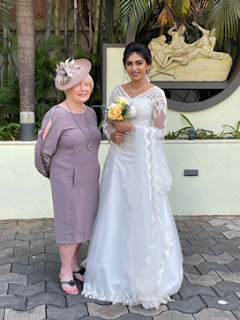
Jurassic Coast Branch Chair at an Indian Wedding by Marjorie Bandy

On New Year’s Eve 2022 I travelled to India to be a guest at a wedding. The sister of one of my friends Clinta was getting married. So why was I invited? A couple of year ago Clinta asked me if I could help her sister Catherine to improve her English as she wanted to move to Canada. With the help of WhatsApp and email we started on “lessons “ once a week, starting with just conversation and progressing to written work with me setting her homework. We started off with a simple thank you letter and over months progressed to her writing short stories. For anyone who knows me you won’t be surprised to read that I sent her work back complete with red ink corrections! It paid off and she passed the exams. She always promised that I would be invited to her wedding

In India unmarried women rarely ever venture out alone or with friends and so have little opportunity to meet members of the opposite sex. Arranged marriage is therefore the norm. At the end of November Catherine sent me a picture of her with a very handsome man with the announcement “ we are getting engaged.” The handsome young man is Akhil who lives on Canada but was home in Kerala specifically to get married. The regulations for taking a wife to Canada meant that the wedding was set for 2nd and 4th January. Initially it seemed that I would not be able to go as getting a visa for India for anyone from the UK is very difficult and usually takes months to arrange. Suddenly in mid-December the rules changed and I was able to apply of an e-visa. All I needed now was a plane ticket. The Jurassic Coast branch to the rescue as Pauline Stow’s son-in-law runs a personalised travel agency. Sorted.

Now for the packing. I had been warned that I would be wearing a Sari for the first ceremony but was specifically asked to look like an English guest complete with large hat for the second. My hand luggage contained little more than said hat.

I flew to Cochin in Kerala State which is predominately Christian and Romain Catholic. The family made me very welcome, and I stayed with a family member. I arrived Sunday and spent Monday getting the necessary jewellery for my sari experience and having the bouse made. The sari colour had already been chosen for me. Next day was the engagement ceremony which took place in the Parish church of the bride. For this the bride and her immediate family all wore the same colour, a rich burgundy. This service is the responsibility of the bride’s family and is followed by a meal and then all of the groom’s family come back to the bride’s house for tea and a piece of cake. This welcomes the joining of the two families. After that the groom and his family leave and we the bride’s side have a party. I asked why the engagement happens in church and Clinta explained that as all marriages are arranged the priest will ask both bride and groom whether they really want this marriage. Church is a safe environment should this be a forced marriage. 


Getting ready for this first event was an experience. A beautician arrived to get me ready, very professional makeup and then I was “dressed” in my sari. I certainly couldn’t have done it myself. Despite wearing the same as everyone else with my blonde hair I hardly blended in.


Wednesday was a rest day albeit I was taken on a sightseeing day.


Thursday was the actual wedding ceremony and unlike here, the Wedding Day is the responsibility of the groom’s family and takes place in their parish church. For this I was able to dress myself. The hat proved to cause a lot of excitement and I can honestly say I have never had my photograph taken so often and with people I didn’t know. 


The bride and groom walk into church together followed by both sets of immediate family, the groom’s mother carrying a basket of gifts, one of which is a sari, and the bride after the service, changes out of her white dress into this. 


After the 1 ½ hour Nuptial Mass [of which I understood not one word] we went to the groom’s family house. After prayers at the entrance and the handing over of the dowry we were all invited in to again have tea and cake. Catherine arriving on the back of Akhil’s motorbike sitting side saddle in white dress and veil and an escort of about 20 bikes of Akhil’s friends. After this we went on to the reception.

After the wedding I had a 3 day escorted trip around Kerala enjoying a peaceful day on a lake houseboat and then up to the hills around Munnar to see the tea plantations and ending in Cochin and the wonderful houses now hotels from the time that India was part of Empire before returning to the airport and a return to wet and windy Weymouth.


Lt Col (Rtd) Marjorie Bandy RRC


Saturday, 31 December 2022

Christmas Memories

On my first Christmas Day in the Army (1989) I had an experience that resembled that of BBC programme, The Vicar of Dibley, when the village vicar was invited to so many lunches that she almost burst.  

I was the Theatre Sister on call at the Queen Elizabeth Military Hospital, Woolwich. After a busy Christmas Eve we had no cases booked on Christmas Day. It was customary for staff with no patients to look after to visit the wards. During the morning I strolled around the wards, mingled with patients and staff and enjoyed the odd mince pie or two. As lunch arrived, despite my protestations that I was having lunch later, one of the ward sisters insisted that I join staff and patients to share the feast. The Army chefs as usual exceeded themselves to make Christmas for those in hospital as enjoyable as possible. I duly joined in, helping myself to the smallest portions I could get away with.
 
On leaving the ward I made my way to Matron's married quarter for a pre-arranged invitation for the living in nurses. I was expecting this gathering to be drinks and snacks but was horrified when a chef turned up with a hostess trolley and proceeded to serve up a full lunch! Again, I attempted to eat as little as was politely acceptable. 

Luckily there was a short interlude before the next intake of food. A group of six of us had planned a late Christmas lunch in one of our flats in the Woolwich Officers Mess for a couple of nurses who were on night duty. This was a full on three course event followed by stilton cheese and port. 

You might think that was as much festive food as anyone could partake of in one day, but no, that evening we were invited to the Commanding Officer's quarters for drinks, games and, you guessed it, more food. I was willing my bleep to go off and save me!

Vast amounts of food aside, the day was memorable for the team work, camaraderie and warmth that was extended to everyone, be they patients or staff, who may not have been spending the Christmas period how they would have chosen.

Moira Dixson (née Horsfall) 


A favourite Christmas memory from my Army nursing days was when I was doing a post-registration course at the Hospital for Sick Children, Great Ormond Street, 1972. On Christmas Eve, a group of us walked from the hospital to St Martin in the Fields for the Midnight Communion service. A cold night, but with pride we walked in our uniforms with our long capes worn inside out with the scarlet lining on show. At the service it was lovely to see other hospitals represented in the same way. A joyful start to Christmas!

Katherine Varden (née Annett)  


1989 and I was selected to attend the Carol Service at the Guards Chapel London, for a televised BBC Songs of Praise. I love singing but have to confess I haven't got a great voice, so thank goodness we didn't have to audition. My family recorded the BBC programme and the camera did rest on my face for a while, so I obviously looked the part! I did feel very proud in my uniform.  We were treated like special guests.

Jan Westbury


Wednesday, 30 November 2022

My First Cenotaph Parade 2022 by Eileen Nolan


I don’t know if any of my relatives ever paid the ultimate price for their country as it was not something ever talked about in our family and now there is no-one left to ask. I know my husband’s uncle was a Japanese POW and suffered dreadfully in what he saw and what he experienced. Thankfully he came home and eventually became a Chelsea Pensioner. We had the privilege of visiting him at the Royal Hospital in the 1980s and meeting other veterans.

What I also know is that two of my brothers and three nephews spent careers in the army and all have seen action in conflict zones including Northern Ireland, the Gulf wars and Afghanistan. Thank God they have all come home but again, it is not something they talk about. Personally, I never went to any conflict zones but I did nurse soldiers who were “casevaced” back to the UK following some dreadful injuries sustained whilst serving their country.

I always watched the Remembrance Sunday Parade with respect for those who did pay the ultimate price and for those taking part. It never crossed my mind however, that I might take part myself until four years ago when my brother told me that he had been accepted to take part in the parade. My heart burst with pride for him and I looked forward to trying to find him as he marched past the Cenotaph. Unfortunately, he was very unwell on the day and was not able to take part and he doesn’t believe he will be fit enough now to ever do it.

From then on, I felt I needed to take part for him and on behalf of my wider family. Things got a bit delayed with Covid but I decided 2022 was going to be my year!

The application process was easy enough but then it’s a waiting game. Numbers have been greatly reduced since Covid and I knew there was no guarantee I would get a place. When the email came through confirming I had been accepted, I was so excited.

In preparation, I took advice from other members of the QA Association who had marched in the past. I was advised to wrap up warm and wear good shoes as I would be standing about for hours. I also realised that I needed to get a beret and a Corps scarf. When my beret arrived, I tried it on….lets face it, I never suited my beret when I was 18 and trust me, I still don’t suit it now at 66! But then again, they are not designed to be a fashion accessory.

The big day eventually arrived and I made my way to Charing Cross station. I had an idea of where I was going but if I had any doubt, I realised I just needed to follow the other berets! I joined the queue at Admiralty Arch at 08.10 and the place was buzzing. It didn’t matter that I didn’t know anyone in the queue as everybody was talking to everybody. Old friends were meeting up and new friends being made.

Once the gates opened, I quickly found B39 where 2 other QA veterans were already waiting. Soon we were 28 and for most of us, it was our first time taking part. Although I didn’t meet anyone I knew, it didn’t matter as everyone was chatting and reminiscing about their time with the QAs. The sense of camaraderie and belonging was palpable.

Yes, we were standing around but time did fly by. The next time I looked up, Horse Guards Parade was packed with thousands of veterans. Everyone was very respectful and it was moving to see the Chelsea Pensioners arrive and the applause which greeted them.

We had to ensure we were in our columns and ready to march out of the parade ground at 10.00. For some reason, I thought we would get more instruction than we did but after we were asked for volunteers to be drill leader and wreath bearer, we were simply told rows of 5. Column B led the parade this year so we were the first into Whitehall. I was shocked at the number of members of the public just outside the parade ground and the amount of clapping and cheering that went up for every contingent as they emerged into Whitehall.

Again, we waited in Whitehall for ages just chatting amongst ourselves and with members of the public. At this stage, I had the honour of meeting Brenda. She had joined the QAs as a trained nurse in 1952 and at the age of 93, decided she would like to take part in the March Past. It was wonderful to listen to her story of her life in the QAs back then.

While we waited, we couldn’t see the Cenotaph and there were 38 contingents in front of us so we didn’t really know how far away we were. We did have a large TV screen beside us so we could see what was going on up ahead and were able to see King Charles III place his wreath.

While we were waiting and watching the screen, there was a bit of a commotion right beside us and when we turned to see what was going on, an urban fox appeared from behind the railings. It sauntered up and down beside us as if inspecting the ranks and virtually posed for photographs! It probably wondered what on earth was disturbing his Sunday morning. It stayed with us for several minutes before disappearing again.


When all the dignitaries had laid their wreaths, we could see the March Past begin on the TV screen and then suddenly we were off!

I have to say that our marching left a lot to be desired at first! Afterall, it had been many years since most of us had marched anywhere…48 years in my case! What didn’t help was that although our drill leader was calling instruction, we were a small contingent and we could hear clearly all the other instructions being given by all the other drill leaders who were often on a different foot from us! After a couple of minutes, our drill instructor changed and left us in no doubt which foot we should be on! Things improved after that…she had clearly done this before!

It was an incredible experience going past the Cenotaph with all the poppy wreaths on one side and then the Salute being taken by Prince Edward on the other side. As we marched, members of the public cheered and clapped and I do believe the cheering got louder when the QAs went past!

As we arrived back into Horse Guards Parade, there was what seemed like a guard of honour with serving soldiers and volunteers clapping and cheering the veterans as they arrived back onto the parade ground. It was a very moving experience.

After the parade, photographs were taken, new friends shared contact details and we prepared to make our way home.

I believe that remembrance is a very personal thing. It is right that the nation formally remembers those who have paid the ultimate price but I also think about those who have served and seen action in conflict many of whom continue to live with their experiences every day and may never be the same.

On reflection of taking part in the Cenotaph Parade, I take away how moving the whole experience was and the respect in which I believe our Armed Services are held. I am proud to have taken part and I will remember the day always.

May the annual parade always continue……….Lest We Forget.


Eileen Nolan – CMH 74-75
BMH Rinteln 1975-1977
Royal Herbert/QEMH 1977-1978


Friday, 4 November 2022

My Time in the Army Reserves by Vivian Maiden

When leaving school, I thought about either nursing or joining the Army. The Army recruitment advised "complete your nurse training then you can apply for a commission", which I did. During my nurse training I heard about the Territorial Army (TA), thought that sounded a good idea, and I could decide later if I really wanted to join the regulars.


My first annual camp


I Commissioned in Sept 1985, Lt Maiden. I was offered a post with a General Hospital, or the Ambulance train and I chose hospital, as I get travel sickness! I was posted to 304 City of Glasgow General Hospital (V), an 800 bedded hospital. In May 1986 I attended the Junior Officer course at the QATC, Royal Pavilion, under the care of Major Marsh. A couple of months later I was in Germany on my first annual camp with 304 General Hospital (V).


I looked in to joining the regulars a couple of times, the first was after I was promoted to Captain. I was told at the recruitment office I would have another year before I could be a Captain in the regulars, so decided I would give myself one year to get promoted in the NHS, which I did, becoming Deputy Ward Sister. The second time was after working at the Queen Elizabeth Hospital for two weeks in 1988, then the following year they came out to do a Hospex with us in Germany.  When I asked how often they did this, many said this was their first time. We completed Hospex every three years. It was then I decided I had the best of both worlds being in the TA.

In 1993, 304 Gen Hospital, 308 Evacuation Hospital, mental health and some other specialist teams merged to become 306 Field Hospital (V) a 200 bedded hospital.

In 2001, it was the year of the USA 9/11 terrorist event.  I had been selected to go on Exercise Saif Sareer 2 with 22 Field Hospital in the October. We reported to 22 Field Hospital HQ and when we were driven out of the camp, a single piper piped us out, I seriously wondered if we were going to Oman or somewhere else! Rest assured we did go on Exercise Saif Sereer, working in the hospital.

In 2002, 306 Field Hospital was involved in another large national exercise, Exercise Log Viper.  A small team and I amalgamated with 22 Field Hospital and for a week I became Matron of 22.

In January 2003 I received my call up papers asking me to report to Chilwell. By the time I received the papers, I had two weeks to sort my life and house out as I did not know when I would be returning. I had been called up to deploy with 33 Field Hospital on OP TELIC 1 as a ward team leader. We started in Camp Coyote in Kuwait where we built the tented hospital. Many TA members were then transferred to Iraq to join 34 Field Hospital who were running the hospital at Basara.


My space at Camp Coyote

I also deployed on OP HERRICK 12B in 2010 as Paediatric lead and Health Care Governance Officer for 34 Field Hospital. It was an interesting post which I loved. It was a total contrast to being deployed on OP TELIC 1 from the accommodation, hospital, and types of patients we received.

In 2008 I was promoted to Lt Col as OC of the Allied Health Professionals Sqn and then subsequent OC posts. In Feb 2017 I became 2IC for the Regiment followed in April 2017 acting CO for the Unit until the new CO took over in Dec 2017. It was a great experience, thanks to an excellent Command team supporting me.


I have now come to the end of my career and after 36yrs and 344 days, I hung up my boots and retired from the Army in August 2022. Throughout my career the key thing that kept me in was friendship. I have friends scattered throughout the UK.  A small group of us became friends on OP TELIC 1, we have met up for a weekend every year since, (except for 2020 due to the Covid pandemic). Next year will be our 20th anniversary.

Lt Col (Rtd) Vivien Maiden


Friday, 30 September 2022

Stories From My Scrapbook - The Falklands by Kay Foster

I was posted to the Falkland Islands in 1987-88 on a six-month tour as Matron at the newly built King Edward V11 Hospital. The previous Military Hospital had burned down with a number of civilian casualties. The Military worked jointly with civilian medical and administration staff as the hospital looked after both the civilian and military population of the islands.  The majority of military personnel were stationed at RAF Mount Pleasant, whereas the military medical staff lived in Port Stanley. At the time of my posting, we were accommodated in portacabins in Port Stanley and had a comfortable Mess, with a church and a pub on the island. 

At that time many foreign fishing vessels from the Far East, Russia and Europe obtained fishing licenses to fish in the fertile fish stocks in waters around the Falklands. The hospital was kept quite busy with a number of trauma injuries suffered by the fishermen.  

The Islands were a perfect wildlife sanctuary, whale's, sea lions, dolphins' various breeds of penguins, also an array of birds including the elegant huge albatross. I even had a wild cat that took up residence with me in my cabin and I would often find a mouse or a bird waiting to greet me. On my days off I would walk the area around Port Stanly and visit the site where the fierce fighting took place, against the Argentine military. There were occasions when I found human bones, e.g. bones from a finger left from the debris of war. We also got the opportunity to get a lift on a working helicopter and visit different areas and islands. 

I visited Fitzroy where the Sir Galahad was bombed with loss of life to the British Troops.  A dear friend L/Cpl Andy Mortimer, REME, was on board at the time and survived the horrific attack by the Argentina airforce. Some years before while serving in Hong Kong I had a return trip on the Sir Galahad to Brunei. I often wonder what happened to the crew of the Sir Galahad, as many foreign staff made the ship their permanent place of work. I had a memorable tour in the Falklands Islands, one of many wonderful postings and experience's I had while serving with the QA’s. 

We featured in Soldier Magazine, as can be seen below.


Major Kay Foster QARANC (Retd) Served from 1977 to 1996

Friday, 2 September 2022

Florence Josephine Reardon (1887 – 1983) by Samantha Ehrenfeld

Florence Reardon c.1917

In my family there is a sentiment “that it is the women who went to war, while the men stayed at home”. This maybe a slight exaggeration, but is fuelled by the respect and reverence we have for our tenacious great aunt Florence Josephine Reardon, who served as a Reserve in the Queen Alexandra Imperial Military Nursing Service.

Born in 1887, in Cootamundra New South Wales, and growing up primarily on her family’s farm Mylbie in Condobolin. Florence’s father William Reardon is rumoured to have been at one point in the early 1900’s the largest landowner in the State of New South Wales, or at least he owned the most sheep! Whatever the rumour, it mean’t his children found themselves in a somewhat privileged position – born into the Australian version of the “landed gentry”, which was ironic as both William and his wife Frances (nee Worthington) were the descendants of Irish and English Convicts – not all of which were your nice’ hanky stealing’ kind.

Being landowners in their own right seems to have spared William and Frances’ sons from enlistment, with their skills needed on the land. However the skills of their daughter Florence Josephine Reardon were much needed, on the declaration of war in 1914.

Florence trained as a nurse at St Vincent Hospital in Sydney, qualifying in 1911. On 18th of December 1915, much to their dismay, and against the wishes of her family (they were of Irish Republican sentiments), she embarked on the Karoola to England to serve a contract as Q.A.I.M.N.S nurse in reserve division.

Florence began her service at the 1st Birmingham War Hospital, and was then posted to Stationary Hospital No.14 in France on the 1st of July 1916.

Florence’s service with Q.A.I.N.M.S.(R) all took place on France’s Western Front, Europe’s main theatre of war, the largest battles of World War I, such as Marne, Ypres, Verdun, the Somme were fought on the Western Front, and an estimated 4 million people dying here.

Florence Reardon in Wimereax

Florence’s also served at Casualty Clearing Stations No 1, 53, 22 and 23, located a few hundred yards from battlefields. They were the first place of admittance for injured soldiers, who underwent treatment within the Casualty Clearing Stations or were held in the Clearing Stations until transferred to other facilities. Casualty Clearing Stations were considered dangerous places, with the noise and vibrations of exploding shells heard from the nearby battlefields.

Florence also nursed in Stationary Hospitals No.10 & 12, these were larger facilities, often centered within pre-war buildings such as seaside hotels. The hospitals grew hugely in number and scale throughout the war. Most of the hospitals move very rarely until the larger movements of the armies in 1918.

During her service Florence became in-firmed on three occasions. In January 1916, Florence became sick, she was herself a patient at No.5 General Hospital, No.2 Stationary Hospital and was then moved to the Nurses Home at Abberville, and later sent to a Convalescent Home in Nice in the South of France to recover. War Office: Directorate Florence served as a nurse with Q.A.I.M.N.S (R), until Armistice in. Demobilised in the United Kingdom in 1919, she worked at the Lord Derby War Hospital in Warrington before returning to Australian on board the Osterly on 8th of July 1919.

Florence was welcomed along- side other returning nurses and soldiers in her home town of Condobolin on 16th of September 1919. The town’s Mayor who was first to speak said:

“No welcome home had given him greater pleasure than this, because in addition to soldiers, they had two nursing sisters, both Condoblin born girls. Every soldier had the greatest respect for a nurse. Often a “digger” would not salute an officer unless compelled to, but he never failed of his own accord to salute a nursing sister “
(Lachlander and Condobln and Western Districts Recorder NSW: 1899 – 1952 Wednesday 17 September 1919, p.4)

Following the War Florence continued to work as a nurse, both professionally and in nursing her father in his later years. She never married, which has led to much family speculation that she may have loved and lost someone during her time on the Western Front.

Florence’s Q.A.I.N.M.N.R Qualification Badge remained in her possession until her death in 1983, when it passed, like most of her possessions to her niece Beryl Reardon. Beryl recalls that Florence never spoke about her time in France, and never applied for the additional Service Medals, once she returned to Australia. It was thought that her experience of “The Western Front’ was one she wished to forget.


Q.A.I.M.N.S (R) Service Badge belonging to Florence Reardon

Florence’s family has always looked upon her service with pride, admiring her bravery. In 2006 Beryl bequeathed the badge to her second cousin, and Florence’s great niece Noelene, who is also a nurse, with the condition that the Badge stay with those in the family who also chose a medical vocation.

Florence’s QAINMS badge is worn each Anzac Day to the dawn service in Kings Park in Perth by one her relatives. Each year an extra pin is added to the fraying ribbon to ensure it is held secure during the service. However next year it is hoped that the badge will have undergone a full restoration, including with a new ribbon.

I have been of two minds with regards to replacing the ribbon. As student of history and archaeology the thought of replacing the original brings forth feelings of desecration. However for my children and grandchildren, I suspect the meaning of the artifact and the recognition of the sacrifice of previous generations will be in its wearing!

Florence is remembered with great pride, not only because of her bravery and contribution to the War effort, but also because Florence signified a new brand of women who chose vocation over home life – participating not only in her own in emancipation, but of those women who would follow her.


Samantha Ehrenfeld - Great Niece of Florence Reardon